

Webzine
[Cover Story “Faith, Religion” #2] Walking the Road Together with Sexual Minorities, and the Meaning of The Queer Bible Commentary| 기간 | 1월 |
|---|
[Cover Story “Faith, Religion” #2]
Walking the Road Together with Sexual Minorities, and the Meaning of The Queer Bible Commentary
A few days ago, I attended the memorial service of Pastor Park Hyung-gyu, a towering figure not only in Korean Christian circles but also in the broader democratization movement in Korean society. He endured countless hardships while resisting the Park Chung-hee dictatorship, and as the Chun Doo-hwan military regime followed, congregants who opposed the Defense Security Command’s ongoing disruption of Sunday worship were forced, from December 1986 to November 1991, to hold their services for seven long years in front of the Jungbu Police Station. It is said that a defining turning point in the life of this once-ordinary pastor came on April 19, 1960, when he happened to witness people collapsing after being shot—an event that set his life firmly on a thorn-filled path.
Perhaps because the day I went to pay my respects coincided with the day Chingusai asked me to write a piece reflecting on “walking together with sexual minorities,” many thoughts surfaced on my way to the memorial.
When I conduct interviews about religion and sexual minorities—with media outlets, researchers preparing academic papers, or university students working on group presentations—one question almost always comes up: What was the turning point?
So here, too, I want to begin by unpacking that “turning point.” In minjung theology, what is often called an “event,” or “the site of an event,” includes the following moments:
The initial gathering of Christians for a World Without Discrimination, formed to resist backlash from Christian groups against the proposed Anti-Discrimination Act in 2007—a moment that marked the LGBTQ+ movement’s shift toward greater visibility, organization, and growth. The overnight occupation protest at the Seoul Metropolitan Council on December 18, 2011, the night before the Seoul Student Human Rights Ordinance citizen-initiated bill passed largely in its original form. And the publication event for <Meeting God as a Homosexual> (hereafter <MGH>), held on the third-floor sanctuary of Hyanglin Church on December 4, 2010.
At a time when it seemed as though the entire Christian establishment opposed the Anti-Discrimination Act, younger colleagues came to the church office insisting that there were Christians who supported the bill and believed it was necessary—and that their voices needed to be heard. I agreed that we could not simply remain silent. Still, I had not anticipated that simply saying “there are Christians here who support the Anti-Discrimination Act” would become the starting point for such fierce attacks.
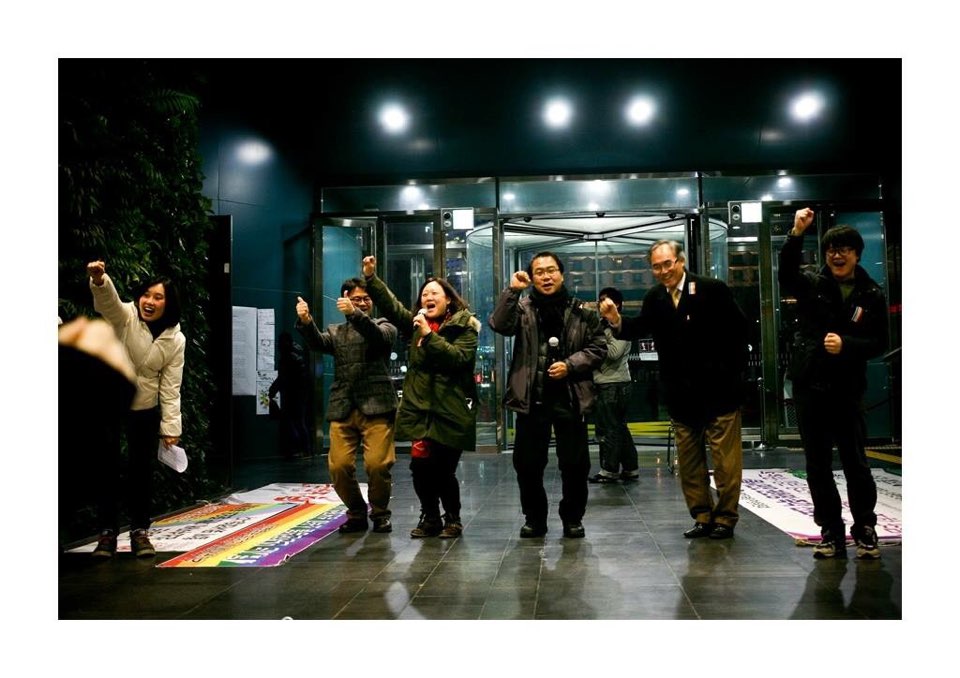
▲ December 2014, at the Rainbow Sit-in for the enactment of the Seoul Citizens’ Human Rights Charter (Photo: Park Kim Hyung-jun)
The sit-in protest in the Seoul Metropolitan Council lobby lasted six days. On the day before the vote, a dark cloud suddenly descended on the site. News spread that passage was uncertain, and the space was quickly flooded with tears—beginning with LGBTQ youth. Even now, whenever I recall or speak of that moment, my eyes fill with tears. Despite occupying the council building to raise our voices, the fear and despair that it might all be erased caused people to break down sobbing throughout the space. When I was asked to lead a prayer service in that moment, I, too, could not hold back my tears. My tears came not only from anxiety or despair, but from witnessing firsthand who was oppressing us, who was trying to isolate and exclude us from society—and how people of faith were betraying Jesus, who preached love and hospitality as the core of their religion, by crucifying him all over again. Those tears of anger became a vow: that I would never forget the tears overflowing in that place.
The event organized to mark the publication of <MGH> began with a time of mourning for those who had fallen victim to Christian homophobia. That space, too, became a sea of tears. During the memorial for Yuk Woo-dang, Jeong Yul, who was speaking at the time, could barely continue through sobs, and the quiet crying and sighs from the audience filled the sanctuary at Hyanglin Church. Deep-seated wounds—traumas each person carried in their chest—were laid bare, and that very exposure became a river of tears. At the same time, it was a moment when we felt how exposing those wounds allowed us to comfort and strengthen one another.
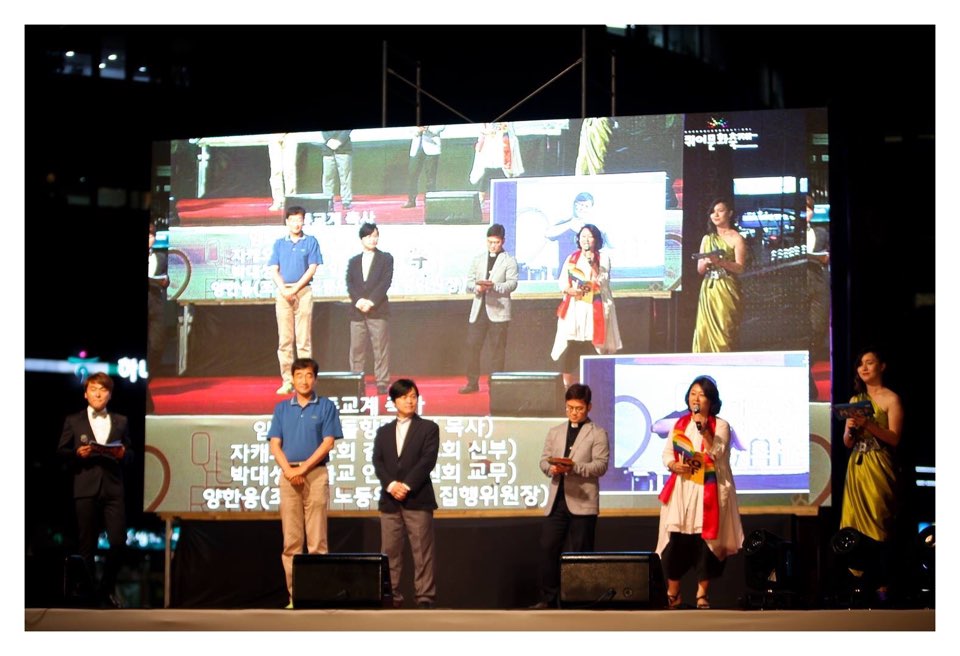
▲ June 2015, at the opening ceremony of the Queer Culture Festival
Now, in 2016, Christian homophobia toward sexual minorities has become even more explicit, widespread, and persistent. At the same time, the LGBTQ human rights movement has diversified, become more visible across many spaces, and public awareness has grown accordingly. That “general public” includes Christians as well. Even as homophobia spreads widely under the banner of Christianity, voices challenging the underlying power structures—rooted in patriarchy and heteronormativity—and calling for fundamental Christian reform are also becoming increasingly visible.
Among the many distorted materials used to incite homophobia, the most powerful tool aimed at used by Christians is the Bible. The very fact that the Bible is weaponized is deeply saddening. Overt acts of hatred disguised as “medical information” are provocative enough, but in Korean Christianity, the authority of the Bible is absolute. With a single phrase—“biblically speaking”—diverse theological frameworks are routinely dismissed as false, nonsensical, or even heretical.
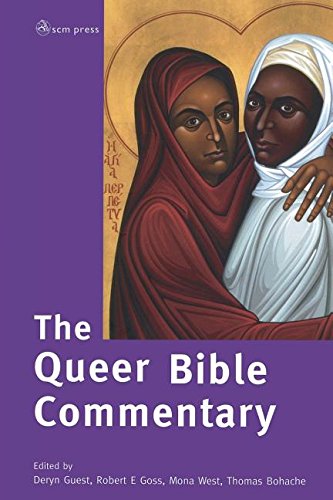
▲ Original cover of The Queer Bible Commentary
It is within this context that the work on The Queer Bible Commentary (hereafter QBC), which began in early 2015, can be understood as a new tributary in the movement resisting anti-LGBTQ religious hatred—led largely by Christians themselves. QBC is a monumental volume that rereads all 66 books of the Bible, from Genesis to Revelation, through theological frameworks attentive to gender and sexuality. In societies like Korea—and even in places where same-sex marriage has been legalized—religion-based homophobia still coils tightly. QBC helps illuminate the connections between LGBTQ lives, religion, Christianity, and the Bible within these contexts. If feminist theology itself has struggled to gain firm footing in Korea, queer theology is even more barren terrain. Among the contributors, only a few—such as Dr. Ted Jennings—are well known in Korea, but around thirty theologians and pastors, widely recognized abroad, participated as authors. Currently, more than twenty people, both in Korea and overseas, have participated or are participating in the translation, which is now about 80% complete.
Those leading anti-LGBTQ movements often single out queer theology for attack, dismissing it as shoddy theology or branding it as heresy unworthy even of being called theology. Yet abroad, queer theology is already an established field, taught as a regular subject in some seminaries. Throughout the arduous translation process—now stretching over more than a year—what repeatedly gave us hope was the passion of those determined to demonstrate, through the act of translation itself, that religion and sexual minorities, God, Jesus, and queer lives are not incompatible or mutually exclusive. Isn’t translation often called a form of new creation? We expect that, by carefully shaping the text so that even non-specialists can read it, and by gathering supplementary materials accessible to readers of many backgrounds, QBC will offer a refreshing cup of living water—not only to religious or non-religious LGBTQ people, but also to non-LGBTQ Christians and non-Christians longing to see the Bible illuminated in a new light.
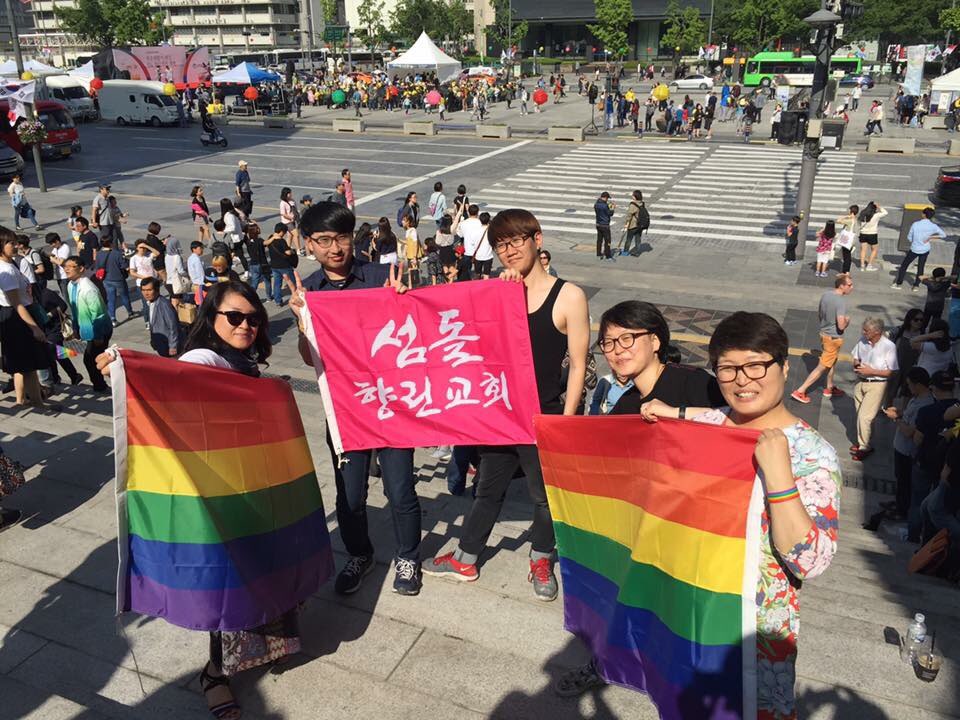
▲ May 2016, at the IDAHOT (International Day Against Homophobia, Transphobia, and Biphobia) event
Countless scholars have defined religion in many different languages. Among the keywords associated with religion, I want to place emphasis on experience and practice. The existence of God should not remain a mere abstraction; it must be something that can be experienced in the midst of ordinary daily life. And that experience should not end as a one-time stroke of luck, but lead to action—living out what has been experienced. To believe that God is love is to pass through events in everyday life where that love is experienced; and that experience, in turn, leads to the practice of extending love to others, just as one has been loved. As queer theologian Father Patrick Cheng puts it, God’s love is so radical that it tears down walls of division and separation. Though this society continues to produce hierarchies, enforce divisions, and normalize exclusion and marginalization, sexual minorities—who have always existed throughout human history—are living proof of what radical love looks like, dismantling arenas of power struggle by their very existence.
Still, we must remember that beyond sexual minorities, there are many other beings who have been erased or oppressed simply for existing. Solidarity—stepping forward together—is an essential part of practicing radical love. I believe it is there that a deeper meaning of existence can begin anew.
<Even for queer people living today, God’s reign instills confidence through the teachings of Jesus. Though we may live as second-class citizens in some places, be unable to marry, have our children taken from us, or even find our love criminalized, there remains, within God’s reign, freedom and liberation for all the world’s people. If we are to encourage others and give them strength as queer people, we must share this good news with everyone we meet.>
— from the Commentary on Matthew, Thomas Bohache
Pastor, Seomdol Hyanglin Church / Lim Bora (임보라)