

Webzine
[No. 174][Contributed Article] To the Rainbow Pilgrims Who Stepped into the Square| 기간 | 1월 |
|---|
[Contributed Article]
To the Rainbow Pilgrims Who Stepped into the Square
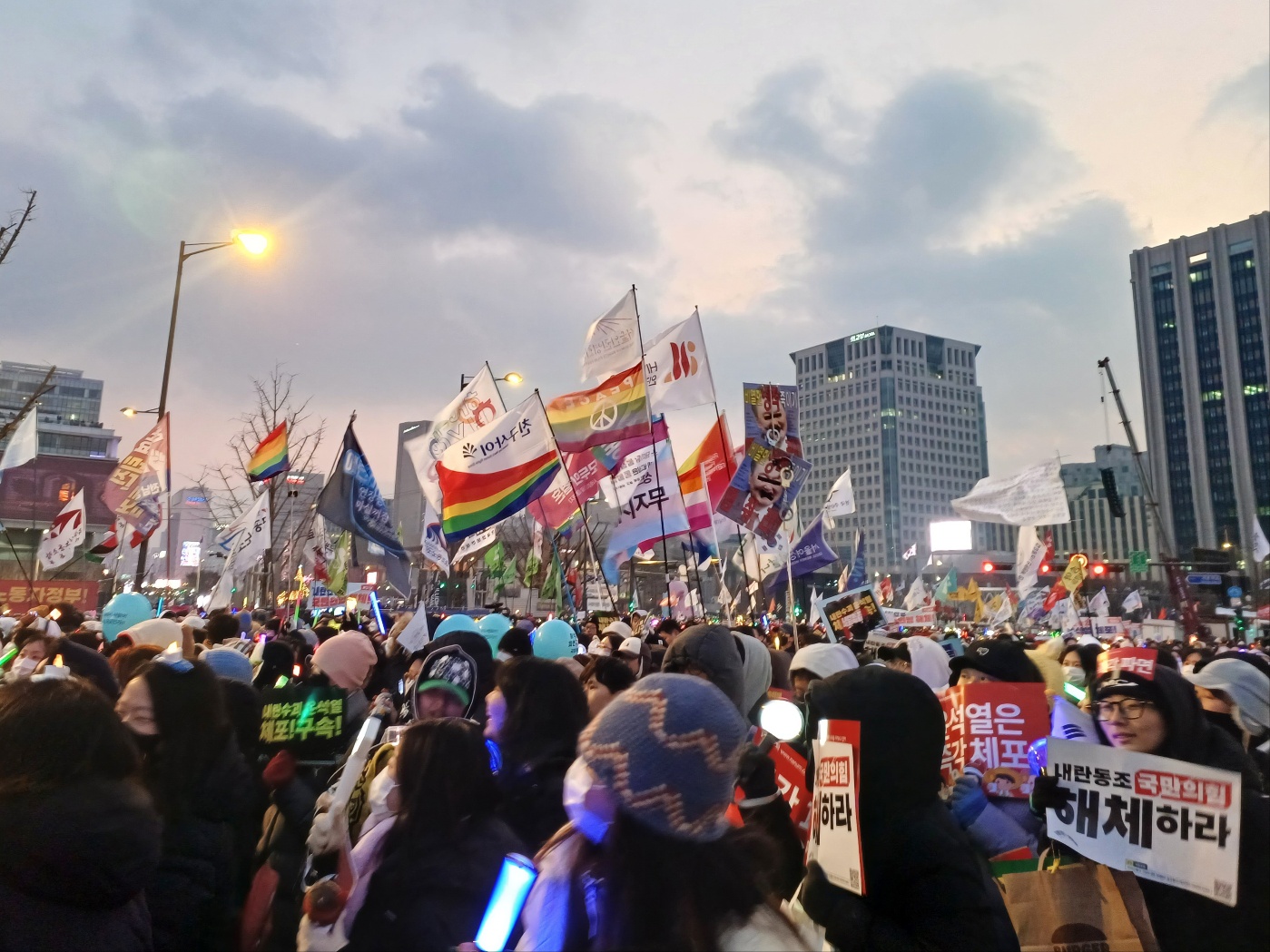
▲ Rainbow flags flying at the <Arrest Yoon Suk-yeol Immediately · Step Down! Social Transformation! Nationwide Civic March> held at Gwanghwamun Square on December 21, 2024
1. Times of Justice
December is a month when, even though the cold wind keeps forcing its way through our thick layers of clothing and makes our bodies hunch involuntarily, our hearts swell strangely with warmth. Last weekend (December 21–22), the Jeon Bong-jun Struggle Group, which had been isolated for 28 hours after being blocked by police barricades in Namtaeryeong, finally broke through the blockade and advanced as far as Yoon Suk-yeol’s residence in Hannam-dong. Thirteen tractors and the thousands of citizens following behind them shouted “Struggle!” while singing <Into the New World> and waving light sticks to the rhythm of <Song of Women Farmers>.
Beginning on the 16th, the struggle group departed from Jinju in South Gyeongsang Province and Muan in South Jeolla Province, calling respectively for “the arrest of Yoon Suk-yeol” and “the abolition of open-market agricultural policy.” When the tractor convoy passed smoothly through Gyeonggi Province and entered Seoul, the police declared the march illegal and threatened to suppress it unless it dispersed (on the 21st). As news spread, citizens who had participated in the nationwide civic march at Gwanghwamun Square gathered at Namtaeryeong after the rally ended, vowing to stage an overnight sit-in and refusing to tolerate police encroachment.
In the early morning hours, when thirty million people slept, participants shared why they were fighting alongside farmers and the futures they each hoped for. Drawing warmth from one another’s words and encouragement, they endured the biting cold of minus ten degrees Celsius. Citizens who could not be there sent snacks and hand warmers, and when hypothermia emergencies occurred, donations were raised to rent and dispatch heating buses.
Even as his own political survival hung by a thread, one high-ranking official—busy shielding the ringleader of an insurrection—slandered the Jeon Bong-jun Struggle Group’s protest as “rioting” and spewed the outrageous remark that “clubs are the answer.” Yet the citizens gathered in the square made clear that freedom of assembly and association is not only one’s own right but also the right of others. Confronting power that sought to suppress those rights by force, they embodied the principle that “solidarity is the answer.”
What made this struggle—often called the “Battle of Namtaeryeong”—so awe-inspiring and moving to many was that a fight led by farmers, long pushed to the margins of Korean society, was ultimately protected through solidarity among people with different vulnerabilities. The slogan from the Jeon Bong-jun Struggle Group’s Ten Articles of Reform—“Abolish hatred and discrimination against women, people with disabilities, migrants, and minorities!”—became a lived reality in Namtaeryeong. It demonstrated that safeguarding farmers’ survival and dignity resonates with a just future. There is no one who has grown up without eating rice grown by farmers, just as there is no sky untouched by the rainbow.
In December 2024, even as I witness rulers attempting to wreck our everyday lives through all manner of contrivance, I also see comrades who refuse to be cowed—checking in on one another and preparing for a new future together. After the late-night declaration of martial law on December 3 failed, citizens rose up to demand severe punishment for the insurrectionary forces that sought to overturn democracy. To defeat those who believed they could seize power with martial law troops and tanks, the weapons we prepared were glowing light sticks and mass K-POP sing-alongs.
I cannot forget the procession of lights that filled the dark streets of Yeouido on the night of the 7th. It reminded me of the fairies—or warriors—of justice from the comics I loved as a child, figures onto whom I once projected myself. “In the name of justice, I will not forgive you.” Like a magical incantation to overcome despair, we hummed K-POP lyrics packed with change and love. The insurrectionary forces may have wanted to claim that citizens with weak “will to resist” had been brainwashed by “anti-state elements lurking in society,” but such logic would have branded Korea’s idols and global K-POP fans alike as anti-state forces—perhaps why they dared not voice it aloud.
Contrary to our hopes, the first impeachment motion was defeated when the ruling party walked out of the plenary session. The next day, the prime minister and ruling party leader announced a maneuver dubbed “Unconstitutional Season 2” (the so-called “orderly resignation”). What we confronted then was not defeat or despair, but the true face of the villains. With greasy smiles, they dressed reaction as conservatism and revealed, with characteristic candor, that the “citizens” they claimed to serve were not us. We named them accomplices to insurrection and gained time to raise once more the light sticks that had emerged to confront injustice.
On the 14th, the National Assembly passed the impeachment motion, halting the violence of the insurrection. Our relief was short-lived. That suspending the duties of a criminal who had aimed guns at citizens and violently invaded the National Assembly barely passed—just over the quorum of 200 votes, with 204 in favor—was infuriating. Recalling that forty million citizens, seventy million people living on the Korean Peninsula, indeed people around the world, had been forced to hold their breath until this obvious decision was made, my anger still surges.
2. The Future Woven by the Rainbow of the Square
In last month’s newsletter article (“‘Emergency Martial Law’: Checking in on You Who Endured That Long Night in Anxiety”), I urged my comrades that it was “time to begin democracy in a queer way.” Yet, to be honest, before this struggle began, I harbored doubts. I feared that if emergency martial law (an insurrection) led to impeachment and a snap election followed as procedure dictated, we would be handed a ballot asking only which president to choose—without ever being given the chance to speak of the society my comrades and I desire.
That fear stemmed from bitter memories of the 2017 presidential election, when self-proclaimed democrats dismissed our existence and the right to love by chanting “later.” In the years since, whenever voices demanded the enactment of an anti-discrimination law, they evaded responsibility by saying “making a living comes first” or “social consensus is needed,” or brushed it off with a smirk and a “that’s enough, right?” Rather than apologizing for their paltry sense of human rights that capitulated to hate groups and condoned discrimination, they continued to proclaim—without shame—that they “oppose homosexuality.” Along the way, we lost Staff Sergeant Byun Hee-soo, who wanted to protect citizens’ lives as a transgender soldier. They also ignored demands for safer workplaces for non-regular workers and for the realization of mobility rights for people with disabilities, even as they touted “rooting out deep-seated evils.”
“At Coupang, workers are dying. In Yongjugol, Paju, sex workers’ lives are being destroyed in the name of redevelopment. At Dongduk Women’s University, university democracy is under threat. In the Seoul subway, the right of people with disabilities to move freely is still not guaranteed. Dating violence against women, the absence of an anti-discrimination law for sexual minorities, discrimination faced by the children of migrant workers, and regional hatred toward Jeolla Province—if all of this remains unresolved, then our democracy is still incomplete.”
— Statement by Eugene, who identified herself as a karaoke hostess, at the Busan Seomyeon impeachment rally, December 11, 2024
Those of us who stepped into the square were not simply recalling the misgovernance of the Yoon Suk-yeol administration. At the Busan Seomyeon rally, Eugene spoke of the wounds left by a democracy that has failed to permeate everyday life. Those wounds are the pain we have witnessed over the eight years since the candlelight protests that ousted Park Geun-hye—pain that has repeatedly returned as guilt and rage. Throughout that time, rainbow flags confronted hate groups, layering one another’s experiences of discrimination atop the wounds others endured, cultivating a sensibility of solidarity. The square of 2024—said to be “different from before”—did not appear suddenly or like a comet; it is the sum of these accumulated memories.
With the hard-fought struggles for equality as its foundation, the square is now constructing a political stage for those pushed aside by society. From the square outward, efforts are made to police hatred and discrimination and to create assemblies that are safe and equal. As flags symbolizing the rainbow and diverse genders flutter, they inscribe the demand that the future of democracy must realize the rights of feminists, queers, and minorities. This is how we break with Yoon Suk-yeol and other discriminationists, and how we open a society unlike the one before. The multicolored waves of light invite us to imagine desires and lives far more diverse than what the single candle of “impeachment” can contain.
I keep turning over the words of a Chingusai comrade who said they still felt an “unresolved frustration” even in the 2024 impeachment square. I recall the faces of comrades who leaned on one another, sharing body heat on the bone-chilling asphalt. I cannot confidently promise that a future unlike the past awaits us at the end of this square, or that a world will unfold where our existence and love are respected. Still, I believe this winter we spent together will be remembered as a struggle that was not lonely. That in the winter of 2024, we fought together to change our lives and to build a world without discrimination. That in a world filled with pain and sorrow, we nurtured love. That though it was bitterly cold, it was warm because of the caring greetings we exchanged. In the new year of 2025, I look forward to greeting you again in the square. Take good care of your health.
“When we went down to Earth, we met those other beings, and many of us would fall in love with someone. And soon we would come to know the world that the one we love stands up against—how full it is of pain and grief. The truth that those we love are oppressed. Olive knew that love also means standing up to the world together with the one you love.”
— Kim Cho-yeop, “Why the Pilgrims Do Not Return,” in <If We Cannot Go at the Speed of Light>, Hubble, 2019, p. 52.
Chingusai / Ram (람)