

Webzine
[Cover Story: Family, Community (I) #1] “The Obvious Wedding” — One Year Later, What’s Changed and What Hasn’t| 기간 | 1월 |
|---|
“The Obvious Wedding” — First Anniversary What’s Changed and What Hasn’t
- Interview with Kim Jo- Kwang-su and Kim Seung-hwan, a married couple
“Mom, we got the apples you sent. Thank you—we’ll enjoy them.”
On the day we were supposed to meet for the interview, a gentle voice drifted through the front door of Chingusai office. Seung-hwan’s mother had sent apples to the home he shares with his husband, KimJo Kwang-su. Seung-hwan called his mom first, asked how she was doing, then handed the phone to Kwang-su, who thanked her warmly. At some point, without much fuss, they had become something it no longer felt strange to call a married couple—a family.
On September 7 last year, at Gwangtonggyo Bridge over Cheonggyecheon, KimJo Kwang-su and Kim Seung-hwan held a public wedding ceremony. They called it “The Obvious Wedding.” That day, they claimed what felt obvious to them: the right to celebrate their love as a loving couple. Among more than a thousand guests, I was there too, sitting beside the person I love. The noise, the excitement, the glowing faces, the homophobic disruption when someone stormed in and threw filth at G-Voice¹—and still, somehow, the ceremony ended beautifully. It was a huge public event, and for the two of them, unforgettable, even if exhausting. One year later, what has changed? And what hasn’t? How have people’s attitudes shifted—or not? How does society look now, through their eyes? We sat down with the couple to talk about what feels different, and what still needs to change.
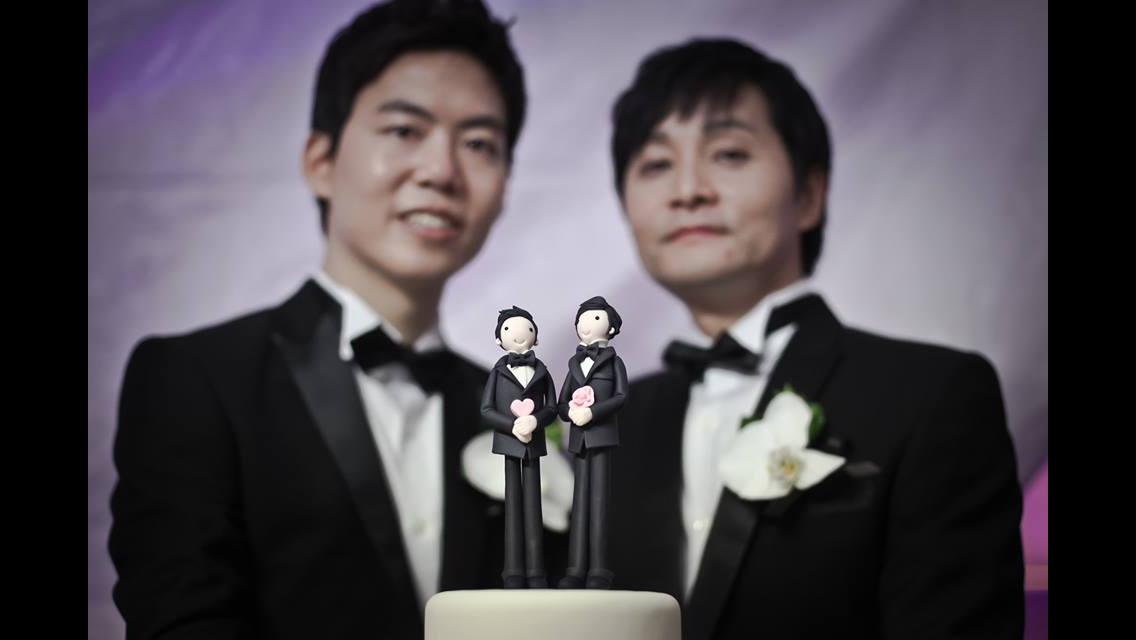
“I’m glad we got married. Just knowing we could.”
They’ve been together for eleven years, but the decision to marry came much later. After six years of being weekend partners, they began living together in the fall of 2009. After more than five years under one roof, was there anything difficult about learning each other all over again?
Kwang-su recalled the moment he moved in. “Honestly, it started as a way to save on living expenses. I moved into Seung-hwan’s place. His parents came by often, and I didn’t want to greet them like I was just some senior renting a room. I wanted to come out properly, someday, and greet them as family. So I avoided them, crashing at friends’ places instead.” Seung-hwan’s father was known for doing background checks—so Kwang-su was extra cautious. Everything shifted in 2011, when Seung-hwan came out to his family. “Kwang-su hyung came all the way down to Busan to support me. That gave me the courage to do it. And then, weirdly enough, just a week later, a journalist who had interviewed him wrote about our plans for a public wedding. We hit number one on the portal search rankings. I remember thinking—well, there’s no turning back now.”
Planning the wedding itself was fast, but far from easy. Convincing parents was the hardest part. Kwang-su introduced Seung-hwan to his own parents first, but Seung-hwan’s family opposed the marriage until the year before last. Still, no parent really wins against their child in the end. After long conversations, they finally agreed—and what followed was, in Kwang-su’s words, “a war.”
“Around this time last year, we were both so stressed that we fought over the smallest things. If we’d just done something small and private indoors, we probably would’ve been happier. I still feel bad about that.” He shook his head as he said it.
But they did get married. And now, a year has passed.
So—what’s different?
“Day-to-day habits? Not much,” Seung-hwan said. “But emotionally, and in how we treat each other—it feels fundamentally different. Before, when we argued, we’d just accept that we were different and move on. Now, after almost a year of marriage, I feel like we’re starting to understand why we’re different. We talk for at least thirty minutes every day, and that helps a lot.”
Kwang-su added that the biggest change was with family. “Before, they saw me as just their son’s boyfriend. Now, I think they really see me as family. Once, Seung-hwan’s dad came to Seoul on a business trip and talked with me—just the two of us—about his daughter’s moving plans. Being consulted about family matters like that felt really good.”
He smiled. “Before, they’d only ask how Seung-hwan was doing. Now they ask about both of us. ‘Are you two doing well?’ ‘Is Seung-hwan healthy?’ ‘Are you coming together for Chuseok?’ Those little things mean a lot.”
Watching them slowly become a family—and seeing how their wedding helped spark broader conversations about same-sex marriage and family rights, even leading to the creation of networks advocating for LGBTQ+ family rights—it’s clear that things have changed. Kwang-su laughed as he put it: “Now people talk about LGBTQ+ rights more naturally. That alone makes me glad we got married. Even a year later, hearing ‘congratulations’ still makes me happy.”
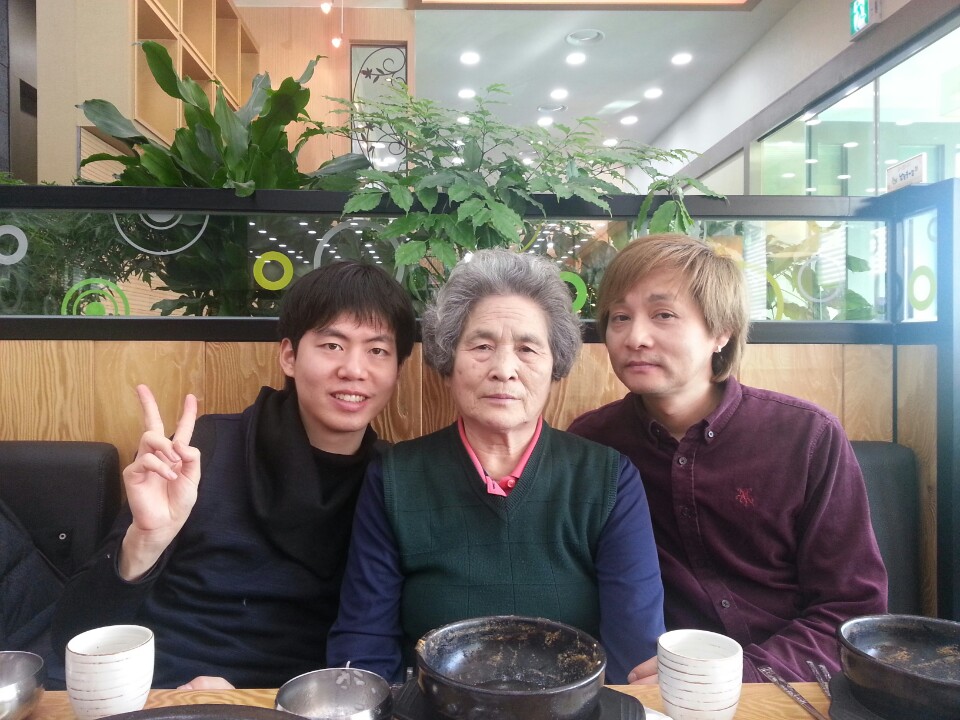
“This is just the beginning—for a community we’ll build together.”
Almost a year into their marriage, the two are still not legally recognized as a couple. When they filed their marriage registration, the Seodaemun District Office rejected it, citing a lack of “mutual consent to marriage.” In response, on May 21—Couples’ Day—they filed a lawsuit challenging that rejection and assembled a legal team.
Kwang-su explained, “There’s nothing in the Civil Code that explicitly bans same-sex marriage. The district office misunderstood the law and made an illegal, unfair decision. They define marriage as something tied to biological reproduction, and family as a unit with parents and children. It’s absurd, but we have to fight it using ‘the language of the law.’ That means we need more people—more actual couples. So within the Family Rights Network, we’re organizing a group of parties directly involved. Our goal is at least ten couples by the end of the year. We don’t need media exposure—just names and cases.”
They’re also moving forward with plans they announced at their wedding: creating a “Sinnaneun Center,” funded in part by wedding gifts, along with a foundation to support it. Seung-hwan shared what’s next. “We’re continuing the Healing Table program with Jung Hye-shin in the second half of the year. And with Yeonbunhong Chima, we’re planning video oral histories of LGBTQ+ people in their 40s to 60s.”
They’re also finishing a documentary about the wedding process, titled My Fair Wedding. You might expect something purely romantic—but when Kwang-su joked that the subtitle should be Love and War, Seung-hwan laughed. “People who saw an internal screening said it felt more like couples therapy. You really see how different we are—and how we still chose to get married.”
Before the interview, I asked people around me what they were curious about most. Almost everyone said: adoption. It felt bittersweet—Korean society still defines family as parents and children—but also meaningful. People were already seeing them as a married couple.
Kwang-su answered as he always has. “Given my age, raising a child until independence feels daunting.” Seung-hwan agreed. “I believe LGBTQ+ couples can raise children just fine—there are plenty of examples abroad. But in this society, I’m still cautious. I worry about what happens when my eyes aren’t on the child. People even joke, ‘It’s been a year—any news yet?’”
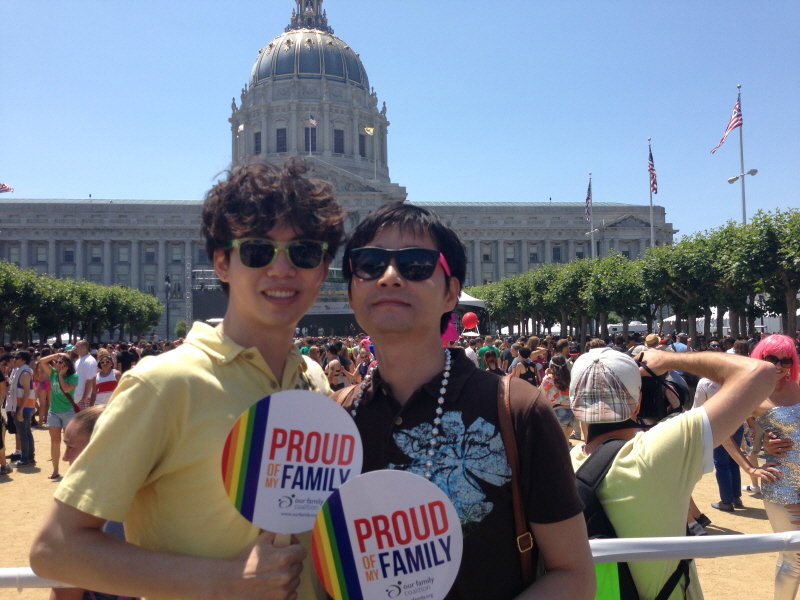
“Being together is a good thing. Everyone should be able to choose that.”
Watching their marriage made me think about my own relationship—about whether living together could someday mean becoming a family, even without marriage. According to the Korean LGBTI Community Social Needs Survey, 87% of respondents said social recognition of marriage or partnership is important, and 80.9% of LGBTQ+ people living with partners reported being satisfied. The desire is clearly there.
We asked the couple what they’d like to say to others dreaming of marriage, family, or community.
“You don’t have to be as public as we were,” Seung-hwan said. “Marriage itself can be a good thing. Having a new family when you’re sick or struggling—that matters. People’s attitudes change. Families change. And if you want a wedding, we’ll help. Dream big. We used the word ‘marriage’ publicly because we believe in equal rights and freedom. Anyone who wants to marry should be able to. And people should also be free to choose other forms of partnership.”
Kwang-su added, “I don’t think everyone has to get married or pair up. But building some kind of community together can be really good. Even though we had a wedding, what we did was ultimately a union between two individuals. We still spend holidays separately sometimes. We don’t force ourselves into old molds.”
Even if I never get married myself, if someone else wants to, that choice should be theirs. Watching the hopes of those who held “The Obvious Wedding”—and maybe our own hopes too—I can’t help but believe that one day, they’ll come true.
Chingusai /Chris (크리스)