

Webzine
[Cover Story: Family, Community (II) #2] Toward New Forms of Family and Law: The Meaning and Need for a Life Partnership Act| 기간 | 1월 |
|---|
Marriage or NOTHING?
Toward New Forms of Family and Law: The Meaning and Need for Life Partnership Act
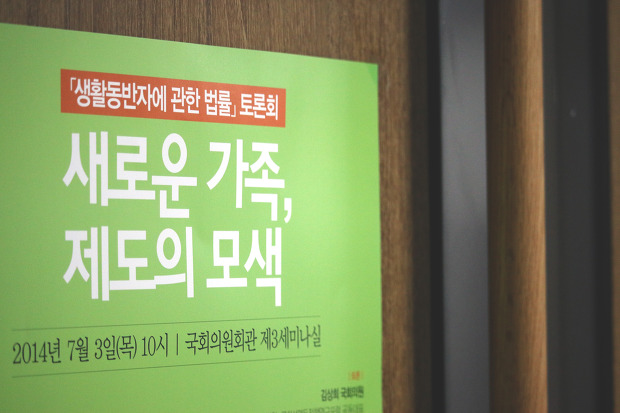
▲ Public forum held on July 3: “Exploring New Families and Legal Frameworks — The Life Partnership Act”
The Need for Institutional Recognition of Same-Sex Couples
According to the 2013 Korean LGBTI Community Social Needs Survey, conducted with 3,159 respondents, 45.3% reported that they were currently in a romantic relationship. Among those, 25.5% (11.5% of all respondents) were living with their partner, and 33.8% of cohabiting respondents had maintained their relationship for more than five years. Despite this, same-sex couples in Korea still receive no institutional recognition whatsoever.
This legal vacuum has at times led to tragic consequences. In the winter of 2013, the media reported the case of two women who had lived together for forty years. Because they were not recognized as a legal family, when one partner suddenly fell ill and passed away, the surviving partner was evicted from the apartment they had shared by the deceased partner’s legal heirs—her nephews. She endured humiliation, was prevented from being present at her partner’s deathbed, and ultimately took her own life.
Reflecting this reality, 86.1% of respondents in the same survey stated that social recognition of marriage or partnership with one’s partner was either “very important” or “somewhat important.” When asked which institutional protections were most urgently needed to sustain a partnership or shared life, respondents most frequently cited: the right to act as family in medical decision-making (67.5%), recognition as dependents under the National Health Insurance system (44.6%), followed by adoption rights for same-sex couples (37.4%), recognition as family in lease succession or public housing applications (29.1%), family benefits in insurance and financial products (27.6%), and survivor benefits under public pension systems (19.9%). These responses highlight the urgent need for institutional recognition of partnerships across healthcare, housing, and social security systems.
Importantly, however, marriage is not the only form of institutional recognition people want. While 59.8% of respondents expressed a desire for legal marriage, 36.1% stated that they preferred institutional recognition outside of marriage, such as civil unions or partnership systems.
Partnership Systems Beyond Marriage
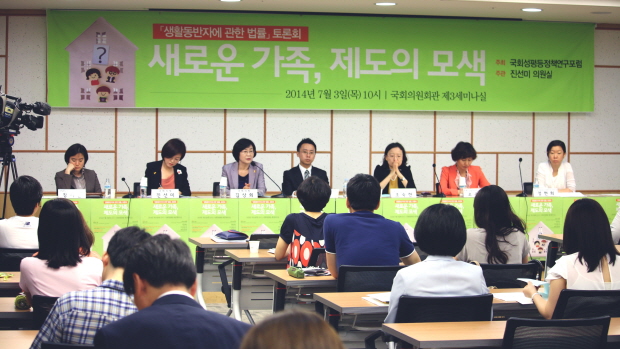
On July 3, 2014, a public forum titled “Exploring New Families and Legal Frameworks — The Life Partnership Act” was held, hosted by the National Assembly Gender Equality Policy Research Forum. At the time of writing, a bill titled the Life Partnership Act was being prepared for introduction, led by National Assembly member Jin Sun-mi.

▲ Public forum held on July 3: “Exploring New Families and Legal Frameworks — The Life Partnership Act”
A life partnership is similar to marriage in that it institutionally recognizes shared life between two people. However, unlike marriage, its legal effects are limited to the individuals involved and do not create in-law relationships with each other’s families. As such, statutory inheritance rights based on kinship do not apply; instead, partners must rely on wills or property division claims upon dissolution of the partnership. At the same time, the proposal seeks to expand social protections and tax benefits for life partners by amending individual laws—such as recognizing a life partner as a dependent under the National Health Insurance Act or granting spousal-equivalent status for basic tax deductions under the Income Tax Act.
Looking abroad, France’s PACS (Civil Solidarity Pact) defines a partnership as “a contract concluded between two adult individuals, of different or same sexes, for the purpose of organizing their shared life.” PACS is available to both Looking abroad, France’s PACS (Civil Solidarity Pact) defines a partnership as “a contract concluded between two adult individuals, of different or same sexes, for the purpose of organizing their shared life.” PACS is available to both
straight couples increasingly opted for PACS, that proportion dropped to 15–20%. In France, marriage is no longer seen as a social obligation but as one option among many, and the symbolic importance of marriage ceremonies has gradually declined. Since the legalization of same-sex marriage in 2013, same-sex couples in France can now choose between marriage and PACS.
Germany, by contrast, established a registered life partnership system exclusively for same-sex couples. While Germany did not recognize same-sex marriage at the time, the legal effects of its partnership system closely resembled those of marriage. Dissolution procedures were similar to divorce, including provisions for post-dissolution support and visitation rights concerning children. Partners could exercise limited parental authority over a partner’s child, and inheritance rights were recognized upon a partner’s death. In effect, Germany created a dual-track system: marriage for straight couples and registered partnerships for same-sex couples.
The Meaning and Substance of the Life Partnership Act
The life partnership bill currently under discussion in Korea closely resembles the French PACS system. Under the proposal, any two adults—regardless of gender—may form a life partnership by mutual consent. Unlike marriage, entering into a life partnership does not create kinship or in-law relationships with the partner’s family. The bill establishes mutual obligations of cohabitation, support, and cooperation. What distinguishes a life partnership from simple cohabitation is precisely this duty of support, which in turn provides the legal basis for extending social security, tax, and financial benefits.
Partners may enter into property agreements governing their shared assets. While Korea’s Civil Code technically allows prenuptial property agreements in marriage, the requirement that they be concluded before marriage has rendered them largely obsolete. The life partnership system allows property agreements—and changes thereto—both at the time of registration and throughout the duration of the relationship. Partners may choose among various property regimes, including full community property or modified separation systems, rather than being limited to statutory separation of property.
Dissolution of a life partnership is also far more flexible than divorce under the Civil Code. Whereas contested divorce requires proof of fault, a life partnership may be dissolved by mutual agreement or at the request of one party. In cases where dissolution results from one party’s wrongdoing, claims for damages are permitted. Upon dissolution, partners may seek division of jointly accumulated property. Until now, Korean courts have recognized property division rights for de facto heterosexual couples but have denied such recognition to same-sex couples, often leaving the non-titled partner without legal protection. The life partnership system seeks to address this gap.
Ultimately, the Life Partnership Act offers different meanings to different people. For some, it provides an alternative to the rigidity or patriarchal assumptions of marriage. For others—such as same-sex couples who currently cannot access marriage—it offers minimal but essential institutional recognition. Partnership systems should not be framed as an either/or alternative to same-sex marriage. In Taiwan, for example, movements for marriage equality and partnership systems have proceeded in parallel. In an era when lifelong, once-only marriage is no longer the norm, and when relationships increasingly take diverse forms—between individuals rather than families, in remarriage, or among older couples—it is worth asking whether society should offer more options beyond marriage alone.
Attorney at Law, GongGam Human Rights Law Foundation / Jang Seo-yeon (장서연)