

Webzine
[Cover Story · Human Rights #2] The Human Rights of Sexual Minorities: Where We Stand and What Lies Ahead — After the Rainbow Sit-in and the Seongbuk-gu Incident, What Should We Do?| 기간 | 1월 |
|---|
[Cover Story · Human Rights #2]
The Human Rights of Sexual Minorities: Where We Stand and What Lies Ahead
— After the Rainbow Sit-in and the Seongbuk-gu Incident, What Should We Do?
Simple, and Yet Difficult
I was asked by the newsletter editor-in-chief to write an article on the theme “The current state and challenges of LGBTQ+ rights as seen through the Rainbow Sit-in and the Seongbuk-gu incident.” Depending on how one looks at it, this topic is both simple and difficult. Put briefly, one could say: “Across administrative and political arenas, there are comprehensive attempts to erase the existence and human rights of sexual minorities, and sexual minorities must fight back against this.”
“The current state of LGBTQ+ rights revealed through these incidents? In institutional politics, LGBTQ+ rights are being ignored, while hate groups that enable this neglect are becoming more organized and amplifying their voices. The challenge? We need to build greater strength and fight more effectively. How? By laying the groundwork to broaden awareness of LGBTQ+ rights and responding proactively to pressing issues. And if we do that? We may gradually overcome prejudice and hatred and win our rights.”
However, statements like these have been repeated ever since the 2007 Anti-Discrimination Act controversy. As a result, it is not easy to effectively capture the terrain as it subtly shifts over time and through successive incidents. This difficulty applies to the growing capacities of LGBTQ+ communities and movements, to the increasingly fragmented and expanding forces of so-called “anti-homosexuality” groups, and also to the international environment that directly and indirectly shapes domestic conditions. It is hard to sum all of these changes up in a single sentence.
Repetition and Change: A Spiral Structure
From the perspective of both domestic and international human rights standards, sexual orientation and gender identity should clearly be specified as grounds for non-discrimination. Yet we repeatedly see that although protections related to these categories are included in initial drafts, they are ultimately deleted after protests from Protestant-centered “anti-homosexuality” groups, with (local) governments or (local) councils stepping in to carry out those deletions. Still, within this repetition, we experience change.
Sometimes it feels like failure, sometimes like success—but participation and solidarity among sexual minorities expand, and social attention grows. These situations inevitably open up spaces for rational discussion around sexual orientation and gender identity, within which the experiences, voices, and narratives of LGBTQ+ individuals become more widely known and gain strength. Sexual minorities remain desperate amid prejudice, insult, and violence, yet they are increasingly less afraid to fight. All of this unfolds within that spiral.
This interplay of repetition and change lies at the heart of understanding both the present condition and the challenges of LGBTQ+ rights. While similar patterns seem to recur whenever an institutional issue comes to the fore, the specific positions and ripple effects shift in a spiral-like structure. This tells us, on the one hand, that the present state of LGBTQ+ rights does not change easily—and on the other, that creating better change will require even greater effort.
The Keyword: “Dignity”
It is worth turning what we have discussed so far back toward our own experiences. Let us recall: last December, during the Rainbow Sit-in, why did you head to Seoul City Hall? What did you feel and think in the City Hall lobby? And how were you after the sit-in ended? Even if you could not be there, what was it like for you as you sent donations, supplies, or messages of support and concern in your heart?
And regarding the Seongbuk-gu incident involving the “Youth Rainbow Together Support Center,” how did you feel sitting in the collective meeting with the Seongbuk-gu district head? What did you think needed to be done—and what still needs to be done and can be done? Or perhaps before even articulating those thoughts, what emotions swept over you? And for those who were not present but heard the news—how did it feel then? And how does it feel now, more than two months later?
Although we may not have talked enough about these experiences, it seems clear that emotions such as anger, sadness, injustice, betrayal, humiliation, regret—and also joy, confidence, pride, awe, relief, and gratitude—intersected. Cutting through all of these emotions was the key concept of dignity. As we re-experienced mockery, disregard, and contempt on a personal level, sexual minorities sought to demonstrate—socially and collectively—that even if they were not treated with dignity, they were already inherently dignified.
Of course, human dignity is the foundation of all rights, and sexual minorities have long spoken about this. But at the end of 2014, Korean society witnessed a stark and dramatic denial of sexual minorities’ dignity. In response, many people demanded that dignity not as an abstract or dispersed notion, but as something with a tangible, visible face.
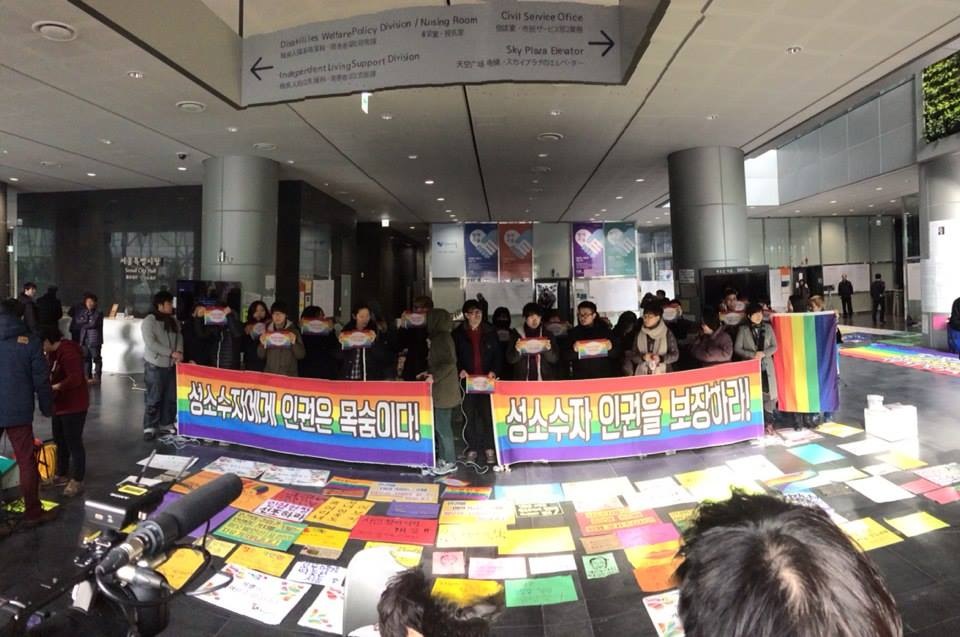
Seoul City Hall, at the closing press conference of the Rainbow Sit-in opposing discrimination against sexual minorities in relation to the enactment of the Seoul Citizens’ Human Rights Charter. 2014.12.11.
A Pathway to Protecting and Restoring Dignity
Within this cycle of repetition and change, we will inevitably encounter such moments again. Yet as always, each phase also takes on a new form. How, then, can we respond more proactively and effectively? How can we prevent the erosion and disregard of sexual minorities’ dignity, and secure rights, love, and change?
There are many ways to approach an answer. One could lay out activities aimed at reducing discrimination and violence across various domains, responses to broader backsliding in human rights, individual struggles to secure specific rights, or strategies tailored to the circumstances of particular organizations or individuals. Detailing all of these exceeds my capacity. What may be possible, however, is to reaffirm the role that Chingusai must play.
One striking aspect of the Rainbow Sit-in was the movement within the gay community. Many people gathered at the City Hall sit-in site, took the lead in fundraising, and raised their voices. It was also a moment when one could tangibly feel the growth and expanded capacity of the community. As a community-based organization, Chingusai must extend this momentum—strengthening its own capabilities while also empowering the community to confront discrimination, prejudice, insult, and violence.
Attacks based on sexual orientation or gender identity are not directed at just one individual but at the entire community. Therefore, it is not for the individual who suffers discrimination or violence to resolve alone; the community must respond together. This is the role Chingusai must fulfill. When discrimination or violence occurs because you are a LGBTQ+ or because you are living with HIV/AIDS, we must be able to fight together—and when you are placed in danger, we must stand beside you to help secure your safety.
To do so, we need to work with our members to identify how to respond when discrimination or violence against sexual minorities occurs, or when sexual minorities are placed at risk; to systematize those methods; to ensure members are familiar with them; to publicize them effectively; and to step forward together in active response. The accumulation of such experiences will give rise to responses that are increasingly mature, wise, and capable of producing real change.
In this way, Chingusai must become a conduit for protecting and restoring the dignity of sexual minorities. Of course, this should go beyond Chingusai acting as a response mechanism to discrimination and violence; it must also involve efforts to transform public institutions so that they, too, respond more appropriately.
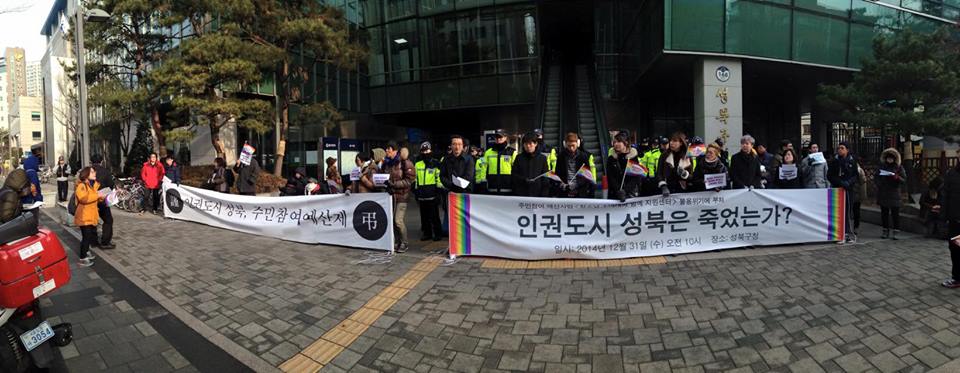
Seongbuk District Office, at a press conference condemning the non-execution of the Youth Rainbow Together Support Center project and police violence. 2014.12.31.
Our Stories and Voices of Support, First
Chingusai has long placed importance on coming out. We have believed that by revealing one’s identity, sharing daily life and personal narratives with those around us, society can gradually be changed. Yet the impression persists that coming out is something only a very few can do. Without the ability to respond to the discrimination and violence that may follow coming out, it often feels impossible.
In such circumstances, coming out requires not only individual strength, but also a community in which Chingusai can stand as a supportive friend—working together to develop ways of responding. Only then can more people gain the confidence and a “shoulder to lean on,” move beyond “double lives,” and live openly as sexual minorities.
Alongside this role—or through it—Chingusai and each of its members must broaden shared understanding with those around them. Through our many stories, people beside us will come to fight alongside us. This becomes even more possible when we do not turn away from the realities of others’ suffering, but stand with them. This is precisely what expanding solidarity means.
Our voices directed toward society must not fall silent. Especially online, hatred overflows and attacks sexual minorities unexpectedly, even when they do not seek confrontation. At such times, Chingusai and its members must raise even more voices of support and articulate their stories more actively, systematically, and effectively. Through the stories and voices of sexual minorities who affirm their own dignity—and of those who stand with them—we can change people, and change society.
This is the task of Chingusai. It is your challenge. And it is my responsibility as well. Creating safe spaces everywhere, making the lives and stories of sexual minorities more visible, and responding collectively and proactively to discrimination, violence, and danger—preparing in advance so that we are no longer merely subjected to harm and erasure. In doing so, we transform “repetition” into “change.” We can create actions and outcomes that go beyond the experience of the Rainbow Sit-in.
There are many things we can begin now, so that we do not have to relive the despair felt in the Seoul City Hall lobby or in the basement cafeteria of the Seongbuk-gu office. Let us start here—but not alone or in exhaustion. Let us do it together. Remembering the faces that shone at the Rainbow Sit-in, let us move forward together.
Head of Legal Support Team, Chingusai / Garam (가람)