

Webzine
[Column] Time Between Times #5: A Certain Sense of Liberation That Is Neither Activism nor Art| 기간 | 1월 |
|---|
Time Between Times #5: A Certain Sense of Liberation That Is Neither Activism nor Art
- Original Songs by the Gay Chorus 'G_Voice'
'G_Voice' is a gay chorus founded in 2003 as a hobby group within Chingusai. There have likely been other LGBTQ music groups that took the stage before them, but 'G_Voice' may be the first gay choir in Korea to sustain its lineage through ongoing performances and recording activities since its founding. Beginning with its first annual concert in 2006, 'G_Voice' also held a 10th anniversary commemorative performance in 2013, filling most of the program with original songs. Following its 9th annual concert, <Coming Out>, in 2014, the group is now preparing its 10th annual concert this year.
A thesis titled <The Cultural Politics of a Gay Men’s Choir> has already been written on 'G_Voice',1) and that work has organized an overall analysis and evaluation of their songs and performances. Here, then, I would like to focus more closely on the original songs that 'G_Voice' wrote and composed themselves, tracing the textures of gay life that those songs depict. I also want to revisit the meanings and resonances of the “male vocal ensemble” form, and to re-examine their position—one that can appear, at first glance, to sit ambiguously somewhere between “activism” and “art.”
A list of 'G_Voice'’s original songs that have been included on albums or performed on stage is as follows.2)
- <Open the Closet Door> (2003): lyrics by Chorusboy, music by Body
- <Peaceman> (2007): lyrics by Garam, music by Chorusboy
- <Memories of the Correctional Facility> (2007): lyrics by Gala & Chorusboy, music by Norma
- <The Boy Next Door> (2007): lyrics by Norma & Chorusboy, music by Norma
- <The Miracle of Jongno> (2007): lyrics & music by Chorusboy
- <Gay Day> (2007): lyrics by Garam, music by Norma
- <Chorusboy> (2008): lyrics by Dongha, music by Chorusboy
- <G_Voice di Gloria> (2008): lyrics by Norma & Chorusboy, music by Norma
- <Nagwon-dong Blues> (2009): lyrics by Cheon Jeong-nam, music by Chorusboy
- <A Cheeky Confession> (2009): lyrics by Norma & Chorusboy, music by Norma
- <The Miracle of Jongno 2> (2009): lyrics by Garam, music by Garam & Chorusboy, arranged by Norma
- <UP> (2009): lyrics & music by Chorusboy
- <Happy Gay Christmas> (2009): lyrics & music by Chorusboy
- <The In-Between Season> (2009): lyrics by Cheon Jeong-nam, Jaegyeong, Garam, Tina, Samgun, & Chorusboy; music by Chorusboy
- <It Isn’t Easy> (2010): lyrics by Sander, music by Chorusboy
- <Memories of a Stray Girl> (2010): lyrics by Laika, music by Chorusboy
- <On the Way to Bukahyeon-dong> (2010): lyrics by Garam, Jaegyeong, & Chorusboy; music by Chorusboy
- <World, I Forgive You Your Sins> (2010): lyrics by Jaegyeong, music by Chorusboy
- <Bravo, My Life> (2010): lyrics by Cheon Jeong-nam, music by Chorusboy, arranged by Norma
- <Congratulations> (2010): lyrics by Cheon Jeong-nam & Ingwan, music by Chorusboy
- <Song of the Alley Cat> (2011): lyrics by Tari & Chorusboy, music by Chorusboy
- <I’m Everywhere> (2011): lyrics by Garam, music by Garam & Chorusboy, arranged by Norma
- <Your Habit> (2011): lyrics by Chorusboy et al., music by Chorusboy, arranged by Norma
- <Love Is Love, Even for a Day> (2011): lyrics by Garam, music by Chorusboy
- <The Road to Me> (2012): lyrics & music by Chan
- <Me, Pulled from the Mire> (2012): lyrics by Seongard & Chorusboy, music by Chorusboy
- <Mom and Dad Have Changed> (2012): lyrics by Homi, music by Chorusboy
- <Superstar> (2014): lyrics by Sang-eonni, music by Chorusboy
- <I’m Done> (2014): lyrics & music by Chorusboy
1. The Calm “Fake”, and the Uncomfortable “Real”
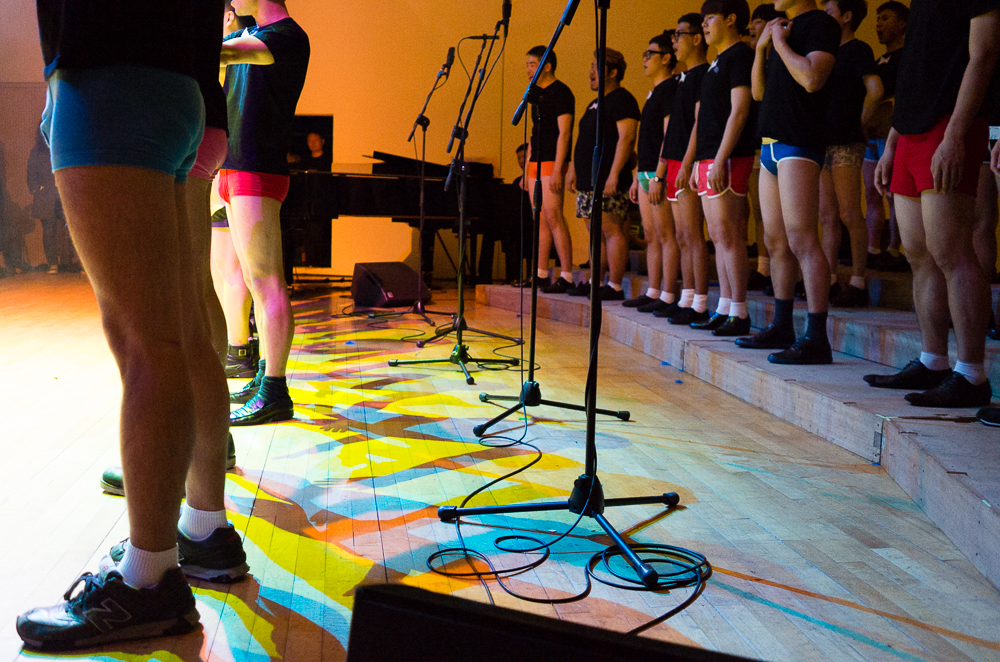
The key reason 'G_Voice'’s performances can be so striking lies in this: every member who takes the stage does so with their face fully open. Their faces appear not only on the day of the performance but also in the printed leaflet distributed to the audience, meaning that a 'G_Voice' concert effectively becomes the members’ coming-out. The performance is staged with that awareness, and the members sing with that awareness. The shock of seeing perfectly ordinary(!) gay men stand onstage without hesitation and sing in chorus about gay life still carries real impact—even as times have changed. In a society where there are not many public figures or activists who have come out, the fact that some thirty everyday gay men can show their faces and sing becomes an experience that fills out what might otherwise sound like an embarrassing word: “miracle.”
This really is the miracle of Jongno
We are the miracle of Jongno
— <The Miracle of Jongno> (2007)
The miracle of Jongno that we created
The miracle of the world that we will create
— <The Miracle of Jongno 2> (2009)
Of course, given the limitations of the male choir form, 'G_Voice'’s stage cannot be described as radically subversive in genre or form. The goal of a gay chorus is not to spotlight one person’s exceptional technique, but to realize harmonies and dynamics built by many voices together. And in terms of lyrical content, most songs depict everyday gay life in an unforced, matter-of-fact way. So the kind of avant-garde sensation one might feel in drag performances at Itaewon clubs—performances that deftly cross and recross the limits of what social norms will tolerate—or in albums like <Iban Basement>, produced by the Korean Sexual-Minority Culture & Human Rights Center (KSCRC), which overtly exposes and satirizes the felt differences between gender identities, is difficult to find in a 'G_Voice' performance.
But 'G_Voice' is by no means limited to highlighting only an easily digestible image of the “good gay” that the general public might accept. Earlier I said that their original songs contain gay everyday life—and it is precisely this unfiltered rendering that brings their performances to life. Just as it is impossible to talk about homosexuality while removing the dimension of sexuality, and just as it is foolish to demand that participants in queer pride parades not display anything “sexual,” 'G_Voice' does not avoid “sexual” stories that can only feel unfamiliar to many and are easy targets for condemnation. In particular, the often-targeted figure of the “feminine” gay man is expressed without exception. In this way, refusing to bleach sexuality out of gay everyday life and choosing the uncomfortable “real” over “fake” calm is one of the central identities of 'G_Voice'’s stage.
Love is love, even for a day—it makes my heart flutter again
Maybe this time, this man is really my fate
But love that’s passed by—truth is, I still miss him
It was short, but it was good; someday he’ll be forgotten
— <Love Is Love, Even for a Day> (2011)
That street I stepped into without thinking / from the bathroom to the square
Eyes that only stared at the ground grow wider / my heavy hips start swaying on their own (...)
Take action, heirs of the stray girl / we host the street
We host it / we host it
— <Memories of a Stray Girl> (2010)
There are plenty of men I want to sleep with, but you’re the only one I want to hold hands with
(You want to, don’t you?)
— <The Miracle of Jongno> (2007)
But that’s not it—what I’m really curious about is
Is his face handsome, is his body good
And his type, and his tastes—yes, his tastes, his tastes, his tastes
I just go along with it, I sing along
— <Me, Pulled from the Mire> (2012)
The moment I saw my friend’s boyfriend / oh my god, someone I know
He’s my ex / did his type change too
I’m done, really / I’m done, it’s fine
It’s not the first or second time
If we keep rotating like this, everyone ends up like family
(It’s fine—even if they call me to a fun place) I’ll live
— <I’m Done> (2014)
Shout—if anyone laughs at me / Fight—if anyone hurts me
Out—run in with a hairpin, throw lipstick, shake your hips and fight
— <UP> (2009)
I’m going to live as a flirt / I’m going to make a new road
Don’t tell me the love I want isn’t allowed
I’ll love with flair / I’ll live with flair
I really am a superstar
— <Superstar> (2014)
2. The Shadow of Pride, and Pride Blooming in the Shadow
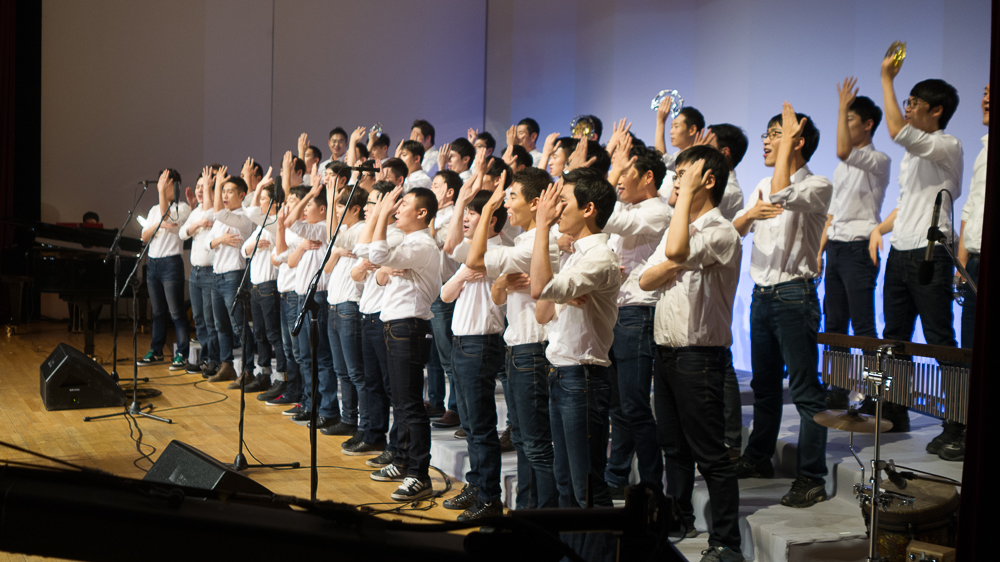
Many of 'G_Voice'’s lyrics contain references to gay pride: coming out, standing confidently in front of others, showing oneself—including one’s sexual identity—and becoming proud through that. This message, aimed at helping gay people feel pride, is in fact obvious; it is both 'G_Voice'’s goal and Chingusai’s goal as well. Yet, as with any important message, repetition can make it feel predictable. At times, their pride can seem almost formulaic—so repeated that it begins to sound stale, like a utopian tale or an activist slogan that has lost its force. For something like “proud pride” that already feels worn into the ordinary, other devices are needed to refill it with substance.
So cheerfully, so happily
And becoming proud again—singing together
— <Me, Pulled from the Mire> (2012)
Love, cry out—youth, sing
Shine in the dark, laugh in hardship
— <Bravo, My Life> (2010)
I realized I’m not alone
I realized despair has ended
— <Open the Closet Door> (2003)
A flame bursting up from deep inside my heart
I will go forward along that path / I will go forward proudly
— <The Road to Me> (2012)
In fact, the public of this era—or the emerging gay public of this era—has already become quite proud. It is no longer the case that the infrastructure of gay culture is as narrow as it once was, and many people build their lives quite satisfactorily on the cultural ground that has been established. In a world where social media allows anyone to promote a polished image of themselves day and night, pride does not seem lacking; if anything, it seems to overflow. There is no need to urge the already-proud to become proud, nor to get in their way. Elevating oneself “to sell,” to become a better version of oneself, is the common sense and the proverb of our time. And yet, many of 'G_Voice'’s songs do not focus only on that polished pride; they also listen to the unpolished story of wounds.
In a world where appearing perfectly fine right in front of others is so important, people often forget the conditions of their own lives in order to maintain that appearance at all costs. For gay men, it is even more common not to fully recognize the conditions they live under—because for those living that life, the problems can be so obvious that it is impossible to remain conscious of them all day long. This is one of the major survival techniques of modern people—and of gay men: living while broadly, selectively forgetting one’s conditions. 'G_Voice'’s songs pull back out those conditions we had forgotten.
After laughing and talking for a long time in a place where everyone is happy
In a swaying back alley, I cough up a breath that’s been blocked
In this world, only stories like a gray fog saying I’m not me
Where is my voice
— <The Miracle of Jongno 2> (2009)
Ah—living like this
Am I really gay, really gay?
— <Gay Day> (2007)
Sometimes time is the hands of a clock turning backward
— <The Road to Me> (2012)
Among the shadows in gay men’s lives, the most powerfully absorbing is despair within love and sexuality: the fear that one cannot love or be loved. This is a problem not only before coming out, but also after. Recognizing and affirming one’s sexual identity is only the first step toward romance; it does not, in itself, help much with the process or fulfillment of romance. Even after one “debuts,” the web of “taste” and “relationships,” and the despair of love and sexuality, easily entangle what anyone would find painful with the particular knots of one’s fate as a gay man. And the moment one’s condition is compared with someone else’s perfectly fine happiness, people fall into feelings they cannot control—like being the only one left behind in this “proud” world.
During the time that could have been ours
The love I confessed to the sky becomes resentment
— <World, I Forgive You Your Sins> (2010)
You who left me / the man I threw away
I won’t believe anymore / I don’t want to believe (...)
People without courage / people who’ve grown tired
Don’t think—just get drunk / our paradise
— <Nagwon-dong Blues> (2009)
Days I cried with envy, comforting you as you ached from love
Your love you can speak, your worries you can speak—maybe that’s happiness
My love I cannot speak—I bury it in my chest, and even that is a sin
— <Bravo, My Life> (2010)
In a society where the demand to look perfectly fine operates like a superego—where living proudly has already become common sense and a form of citizenship—looking back at oneself is not easy. In that context, 'G_Voice'’s songs that sing the shadow of gay life feel like they pry open and peel away the thick shell one had to harden in order to survive. And one is forced, once again, to face the newly visible conditions of one’s life: not that sorrow is simply “fine,” but that sorrow is precisely aimed at as sorrow—bringing relief, as if something inside loosens and one’s emotional center is set upright again. From there, it becomes a pride not for being seen by others, but for standing oneself upright. And the familiar prides—the familiar pride, the familiar Pride, the familiar confidence—gain new meaning when measured against the depth of despair one has managed, with difficulty, to face.
On a cold winter night, I saw
It was more beautiful than any prayer
Licking each other’s wounds
Sharing a sky no one else can have
— <Song of the Alley Cat> (2011)
Take me to Ahyeon-dong, my poor neighborhood
An alley where my ugly shoulders grew a little wider
Where a song would form on its own
On this road, at least, I become the protagonist
— <On the Way to Bukahyeon-dong> (2010)
Let’s go, let’s go up the hill
To the hill where flower-winds blow
So your sorrow will carry a scent
Let’s pin flowers to our chests
— <The In-Between Season> (2009)
In those moments, one briefly awakens to oneself as a gay person—and further, as a human being. Against memories of having scraped out one’s insides just to appear fine, and against the voices of those who did not want one to be human, 'G_Voice'’s songs quietly open a short moment in which one is at last affirmed as a full, complete gay person and human being. The passage that replaces “I confess my sins” with “I forgive the world’s sins” is the moment when a fragmented inner self—dismissed as inferior in a world of people who look fine, treated as something that could simply disappear—is dramatically lifted up and allowed to see its own light. It is a Copernican reversal: what mattered no longer matters, and what did not matter becomes what matters. This experience of reversal, conversion, and healing is an achievement 'G_Voice' can rightly call remarkable.
Now I’m going to leave
I can’t endure this world any longer
Don’t try to understand me
I have no heart left to forgive this world either
— <Bravo, My Life> (2010)
World, I forgive you your sins
It was love, and love again
World, I forgive you your sins
It was love, and love again
— <World, I Forgive You Your Sins> (2010)
3. A Certain “Liberation” That Is Neither Art nor Activism
Of course, 'G_Voice'’s future is not bright in every way. As a male choir, it may be difficult to satisfy members’ musical and performative desires, and just as pride can become formulaic, stories of gay pain and wounds also risk being received as cliché. Above all, as gay society grows, cultural communities that come out are emerging one by one—making it feel as though 'G_Voice'’s relative advantage is fading. Of course, seen from the perspective of gay society as a whole, this is something to welcome.
Then, if gay people were to gain full citizenship, would this choir’s reason for existing disappear? If, as some say, the ultimate goal of the gay human rights movement is a world in which the gay human rights movement no longer needs to exist, then when the day comes that no gay person is oppressed—should this choir happily dissolve?
My song is buried under the irritable cry of cicadas
The shy passion—those green days
Has faded with time
— <Memories of the Correctional Facility> (2007)
Regrettably, that day seems far away. New homophobic organizations of every name continue to rise, and we are repeatedly forced to confront just how deep structural hatred and phobia run within the clouds of unexamined ignorance that “ordinary citizens” carry. In such circumstances, it is reasonable to be optimistic about 'G_Voice'’s lifespan for now. And I also expect that their sensibility—moving back and forth between gay pride and gay despair—will, at least for the time being, continue to shine without falling too easily into the swamp of formula and cliché.
Liberation swelling through musical notes
Shoulders bound together by harmony
— <The Miracle of Jongno 2> (2009)
We have to become happier
So there is much we must do
For you who endured hardship
Everybody, congratulation
— <Congratulations> (2010)
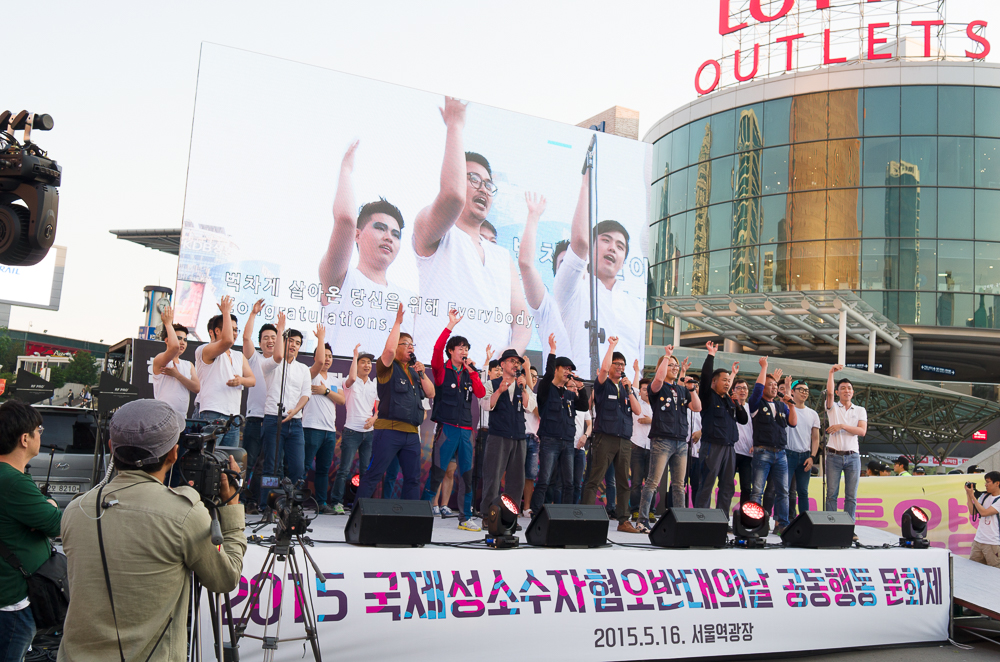
On May 16, 2015, at Seoul Station Plaza during the International Day Against Homophobia and Transphobia (IDAHOT), the SsangYong Motor branch choir <Dreaming Together> from the Korean Metal Workers’ Union and 'G_Voice' shared one stage. In a single voice, the two choirs sang <Congratulations>, an original song by 'G_Voice', and performed 'G_Voice'’s choreography together. The sight of the voices of laid-off union members and a gay chorus mixing within one song showed how the “conversion” of a minority—finding hope and pride in the depths of despair—can make eye contact with so many other things in the world.
Please—you have to say it
So it won’t disappear
— <On the Way to Bukahyeon-dong> (2010)
Finally, amateur choirs like this one, which work to cultivate gay pride, always face a particular question: “Are you doing activism, or are you doing art?” Embedded in the question is the assumption that such activity is neither activism nor art—a vague, in-between state—and, further, the notion that such a balancing act is somehow “inferior” to choosing one side and devoting oneself to it. It is true that there are parts of 'G_Voice'’s work that cannot be neatly labeled activism or art—setting aside how difficult it is to manage that “in-between” tightrope well.
But their position is not an “in-between” form to begin with. It is not an ambiguous middle that must always be unstable between two poles; it is, clearly, another pole altogether—its own realm and stage. So there is no reason their pursuit should be deemed “inferior” simply because their goal does not sit at either extreme of “art” or “activism.” Their activity can be activism, and it can be art. And beyond that—what would it matter if their songs were not activism, or not art? From the beginning, they have another aim they want to pursue. If healing, achievement, and a sense of liberation are gained there, who could dismiss it as something “half-baked”?
If you are curious about what that liberation actually feels like, I recommend meeting the members of 'G_Voice'. Some of them will surely answer heavy questions like these in the following way:
“Activism? I don’t really know about that—I just like singing, so I go on stage.”
_
Footnotes
1) Bae Jae-hoon, <The Cultural Politics of a Gay Men’s Choir>, MA thesis, Graduate Program in Cultural Studies, Yonsei University, 2012; Bae Jae-hoon, <The Cultural Politics of a Gay Men’s Choir>, <Feminist Theory> 31, Nov. 2014.
2) This list is a reorganized version of the contents on pp. 64–66 of <Chingusai: 20-Year History>, published by the Korean gay human rights organization Chingusai, 2014.
Chingusai / Teoul (터울)